
Fleet Truck Insurance: What You Need
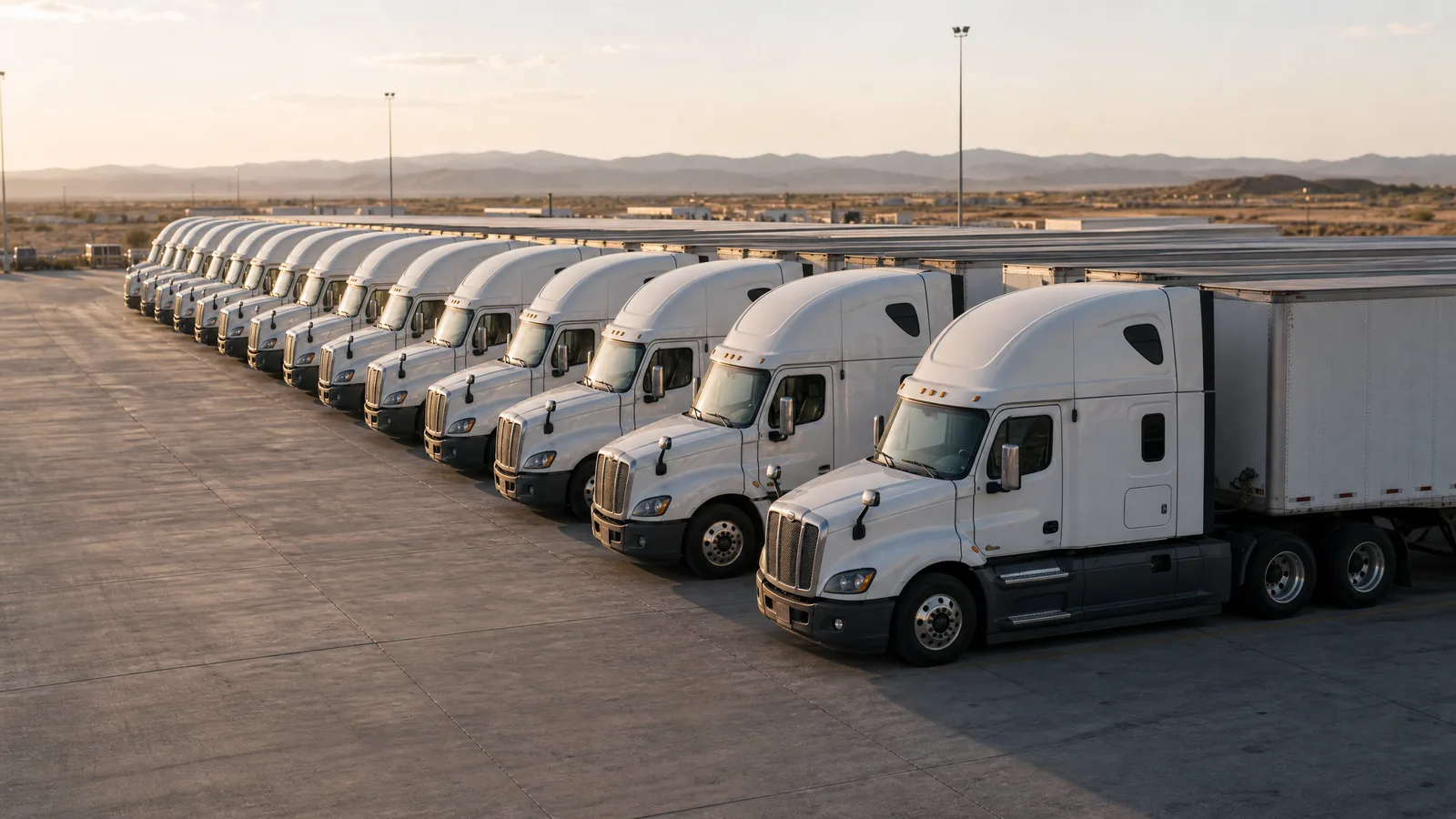
Fleet insurance covers commercial trucking operations with multiple trucks under common ownership. The insurance products are the same as single-truck operations (commercial auto liability, cargo, physical damage, general liability) but the structure changes significantly. A fleet typically operates under a single master policy that covers all trucks, all drivers, and all cargo under unified coverage limits and conditions. This simplifies administration, qualifies the fleet for volume discounts, and opens access to fleet-specific underwriting programs that single-truck operators do not have.
The transition from single-truck to fleet usually starts at 3 to 5 trucks. The transition from small fleet to large fleet (with access to loss-sensitive programs) typically starts at 25+ trucks. Each step up in fleet size opens new pricing structures and coverage options.
Fleet vs. Individual Truck Policies
The structural differences between fleet master policies and individual truck policies:
| Feature | Individual Truck Policy | Fleet Master Policy |
|---|---|---|
| Pricing basis | Per truck, separate quotes | Per truck with volume discount |
| Driver management | Named driver per policy | Schedule of drivers, easy adds/removes |
| Renewals | Each truck separate | Single renewal date |
| Claims handling | Separate adjusters | Dedicated fleet adjuster |
| Loss-sensitive options | Limited | Available for larger fleets |
| Safety program requirements | Minimal | Often required for larger fleets |
| Per-truck cost | Higher | Lower (volume discount) |
Fleet Volume Discounts
Per-truck premium typically declines as fleet size increases. The major thresholds:
- 3 to 5 trucks. First step into fleet pricing. Per-truck cost drops compared to buying individual policies, because fixed program costs spread across more units.
- 6 to 10 trucks. Additional discount; opens access to more carriers that have minimum fleet sizes for fleet programs.
- 11 to 25 trucks. Mid-market fleet pricing. Formal safety programs begin to matter; some carriers require dashcam programs or driver training documentation.
- 25 to 50 trucks. Access to loss-sensitive programs (higher deductibles, SIR options).
- 50+ trucks. Wide range of coverage structures available, including captive insurance arrangements for the largest operators.
Coverage Types for Fleets
- Master commercial auto liability. Single policy covering all trucks. FMCSA minimums apply per truck. Most fleets carry $1 million primary; many add $5 million to $25 million umbrella.
- Master cargo insurance. Single policy covering all trucks, with limits scaled to the highest-value cargo any truck might haul.
- Physical damage on each unit. Scheduled by truck. Each tractor and trailer listed with VIN and value.
- General liability. Master policy covering operations across all sites and trucks.
- Workers compensation. Required by most major shippers; covers all employees across the fleet.
- Employer's liability. Pairs with workers comp; covers employer liability claims that fall outside workers comp.
- Hired and non-owned auto. Covers liability for vehicles the fleet does not own (rental trucks, owner-operator trucks under trip-lease, employee personal vehicles used for work).
- Trailer interchange coverage. Covers physical damage to trailers owned by other carriers in the fleet's care.
- Pollution liability. For hazmat fleets or any fleet with environmental exposure.
- Umbrella / excess liability. Stacks additional limits above primary auto, general liability, and employer's liability.
- Cyber liability. Increasingly important as fleets adopt digital dispatch, ELDs, and customer portals.
- Crime coverage. Covers employee dishonesty, theft, and forgery.
- Employment practices liability (EPLI). Covers claims of wrongful termination, harassment, and discrimination.
Fleet Safety Programs and Their Impact on Premiums
Fleet safety programs are formal management systems designed to reduce accident frequency and severity. Most insurers either require or strongly incentivize safety programs for fleets above a certain size. Common components:
- Driver qualification files (DQF). FMCSA-required for all drivers. Insurers want to see DQFs maintained and current.
- Pre-employment screening. MVR review, drug testing, employment verification, road test.
- Continuous MVR monitoring. Annual MVR pulls or continuous monitoring services.
- Drug and alcohol testing. FMCSA-required pre-employment, random, post-accident, and reasonable suspicion testing.
- Driver training. Defensive driving, hazmat training (for hazmat fleets), securement training (for flatbed), specialized training for hazardous routes.
- Telematics and dashcams. ELDs are required; fleet-grade telematics often track speeding, hard braking, and lane deviation. Forward-facing dashcams document accidents and reduce liability claim frequency.
- Accident review process. Formal review of every accident with documented preventability determination and corrective action.
- Safety committee. Larger fleets often have a formal safety committee that reviews accidents, identifies trends, and implements policy changes.
Documented safety programs earn premium credits at renewal compared to fleets without them, and they matter more as fleet size grows.
Loss-Sensitive Programs for Larger Fleets
Fleets with 25+ trucks and strong safety performance can access loss-sensitive programs that reduce premium by retaining more risk:
- Large deductible programs. Fleet pays the first $25,000 to $250,000 of each claim. Insurer covers the layer above. Premium drops because the insurer is paying fewer dollars.
- Self-insured retention (SIR). Similar to large deductible but the fleet handles claim adjustment up to the SIR. Most useful for fleets with internal claims management capability.
- Captive insurance. Fleet (alone or with others) forms its own insurance company to cover its risks. Captives can be cost-effective for very large or specialty fleets.
- Risk retention groups. Group captive structures where multiple similar fleets pool risk under a shared captive arrangement.
Loss-sensitive programs only work for fleets with strong cash reserves, formal claims management capability, and stable loss experience. They are not appropriate for smaller fleets or operators with frequent claims.
How Much Does Fleet Truck Insurance Cost?
Per-truck cost generally falls as a fleet grows, because fixed program costs spread across more units. Cargo class pushes it back up. Ordered from lowest to highest typical premium, holding driver record, operating radius, and coverage limits constant:
- Large fleet (25+ trucks), general freight (loss-sensitive structures may cost less)
- Mid fleet (11 to 25 trucks), general freight
- Small fleet (3 to 10 trucks), general freight
- Reefer fleet
- Hazmat fleet (depending on commodity)
- Oilfield service fleet
For a deeper breakdown by truck type and coverage type, see our commercial truck insurance cost guide.
How to Get Fleet Insurance Quotes
Information you will need:
- Number of power units, trailers, and equipment
- List of all tractors and trailers (year, make, model, VIN, value)
- List of drivers with CDL info and MVRs
- USDOT and MC number
- Cargo types and operating model
- Operating radius and lanes
- 5-year loss history (auto liability, cargo, workers comp)
- Existing safety program documentation
- Major customer contracts and their insurance requirements
Find an agent who writes fleet trucking insurance. Tell them how many trucks you operate, what you haul, and what level of program (master, large deductible, SIR) you want quoted.