
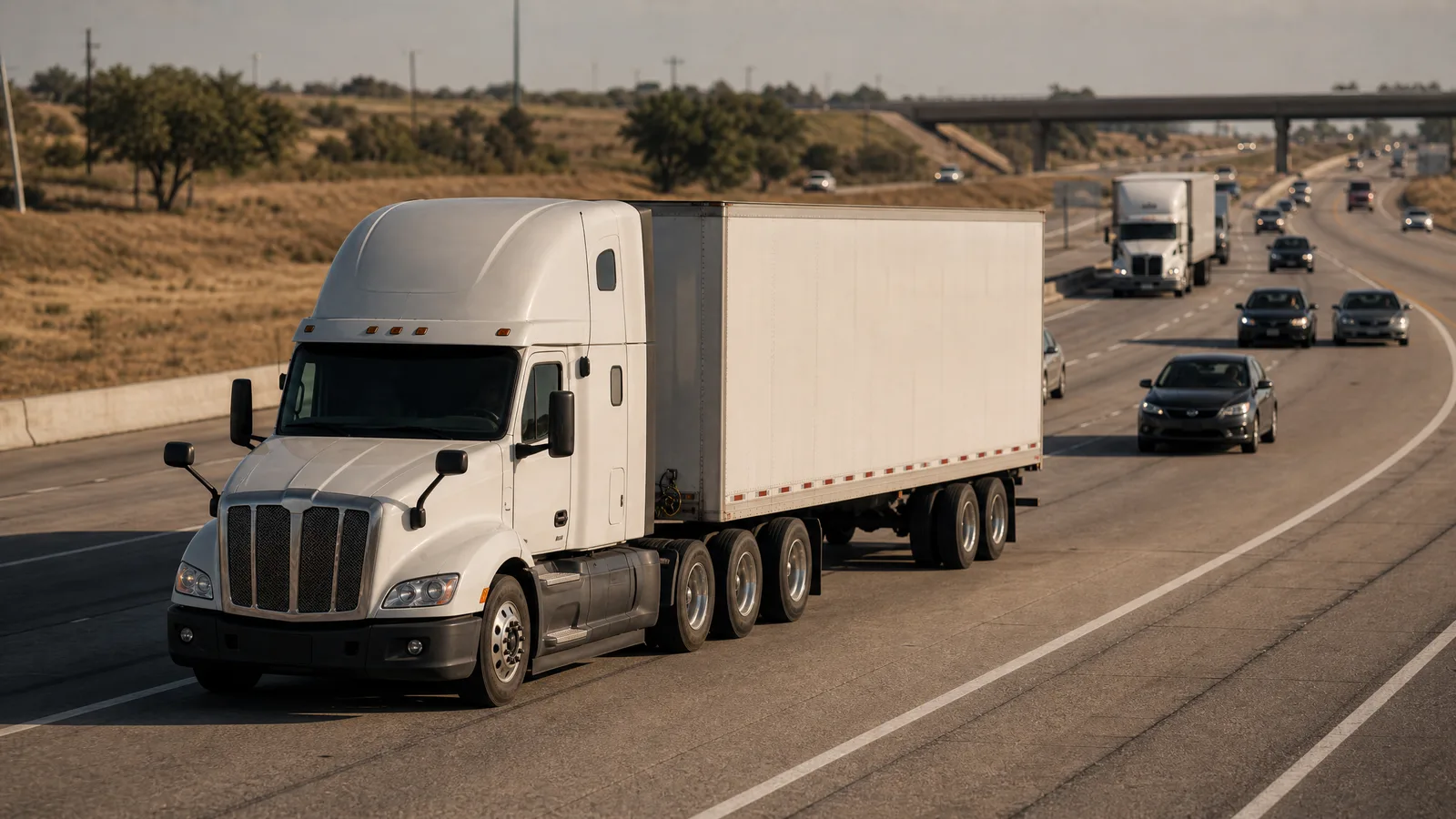
What Commercial Auto Liability Covers
Commercial auto liability is the foundation of every commercial trucking insurance program. It pays for bodily injury and property damage you cause to other people while operating your truck. Federal law requires it for every for-hire interstate carrier. State law typically requires it for intrastate carriers. Almost every freight contract requires it. There is no commercial trucking operation that does not need it.
The policy pays for:
- Bodily injury to other drivers, passengers, or pedestrians caused by your truck
- Property damage to other vehicles, structures, or property caused by your truck
- Legal defense costs if you are sued (typically in addition to the policy limit)
- Settlements and judgments up to the policy limit
The policy does not pay for:
- Damage to your own truck (covered by physical damage)
- Loss or damage to the cargo (covered by cargo insurance)
- Your own injuries (covered by workers comp or occupational accident)
- Pollution-related claims (typically requires separate pollution liability)
- Intentional acts
Combined Single Limit (CSL) Explained
Modern commercial trucking liability policies use a combined single limit. A $1,000,000 CSL means the policy pays up to $1 million total per accident, regardless of how the claim splits between bodily injury and property damage. If a single accident produces $700,000 in bodily injury claims and $300,000 in property damage, the CSL pays the full $1 million.
The alternative structure, split limits (such as 100/300/100), separates limits for per-person bodily injury, per-accident bodily injury, and property damage. Split limits are rare in commercial trucking today and most operators encounter them only on personal auto policies.
FMCSA Liability Minimums
Federal liability minimums for for-hire interstate motor carriers (49 CFR 387.9):
| Cargo Type | Minimum Liability (CSL) |
|---|---|
| General freight (non-hazmat) over 10,001 lbs GVWR | $750,000 |
| Household goods | $750,000 |
| Oil transport (non-hazmat) | $1,000,000 |
| Most hazardous materials | $1,000,000 |
| Poisonous gases and certain hazardous materials (49 CFR 171.8) | $5,000,000 |
These are minimums. Most major shippers, brokers, and contract operators require limits above the federal floor. $1 million is the de facto baseline for general freight in commercial trucking. $2 million primary or $5 million umbrella is common for fleet operators and higher-value freight.
Why Most Operators Carry Above the Minimum
Several factors push operators above the FMCSA floor:
- Broker and shipper requirements. Most freight brokers expect $1 million minimum. Many direct shippers require $2 million.
- Lease agreement requirements. Motor carriers leasing operators often require $1 million in primary, with the carrier listed as additional insured.
- TxDOT and government contracts. TxDOT sets contractor insurance in Standard Specification Item 3 and primes flow those requirements down, so the limit that applies to a subcontractor is the one written into that subcontract. Read it before quoting.
- Catastrophic claim potential. Multi-vehicle accidents involving commercial trucks can produce verdicts well above $1 million. Operators with personal assets to protect typically carry higher primary limits or umbrella coverage.
- Marginal cost is low. The cost per additional $1 million of limit falls as you go up, so the second million in umbrella typically costs less than the first million in primary. Ask your agent to quote several limits side by side and you will see the curve.
How CSA Scores Affect Your Premium
CSA (Compliance, Safety, Accountability) is the FMCSA's safety measurement system. It tracks motor carrier performance across seven categories called BASICs:
- Unsafe Driving (speeding, reckless driving violations)
- Hours of Service Compliance
- Driver Fitness (medical certification, CDL status)
- Controlled Substances/Alcohol
- Vehicle Maintenance
- Hazardous Materials Compliance
- Crash Indicator
Scores are calculated from FMCSA inspections, roadside enforcement, and crash records. Carriers above intervention thresholds in any BASIC face additional FMCSA scrutiny. Insurers use CSA scores in rating: bad Unsafe Driving, Hours of Service, or Vehicle Maintenance scores can produce premium surcharges or, at the worst end, non-renewal.
CSA scores apply to motor carriers (operators with their own FMCSA authority). Leased owner-operators do not have their own CSA scores; the motor carrier they are leased to has the scores.
How to Get Commercial Auto Liability Quotes
Commercial auto liability is usually quoted as part of a full commercial trucking insurance package. The same agent typically writes liability, cargo, and physical damage on a single policy or coordinated package.
Find an agent who writes commercial trucking coverage in Texas. Tell them what you haul, what limits your customers require, and what other coverages you need. The right agent will quote multiple carriers and find a policy that fits your operation.